
Your cover is the only part of your book every potential reader sees, including the ones who never buy it. Choosing who designs it is the highest leverage hire in self-publishing, and most authors choose on the weakest evidence available: pretty front cover mockups in a portfolio, floating over blurred backgrounds, at sizes no reader will ever see. We design covers for a living, so consider this us handing you the test we would want graded by, including the parts that make some designers uncomfortable.
Judge the portfolio like a publisher
Genre fluency first. A designer brilliant at romance covers may be wrong for your business book. Look for repeated success in your genre and its neighbors, because genre is a visual language readers decode in half a second, and fluency in it cannot be faked with general talent.
Typography, not just imagery. Covers fail at thumbnail size through weak type far more often than through weak pictures. In the portfolio, shrink the covers mentally to postage stamps: can you still read title and author, and does the hierarchy survive? If the type dissolves, so will your sales page.
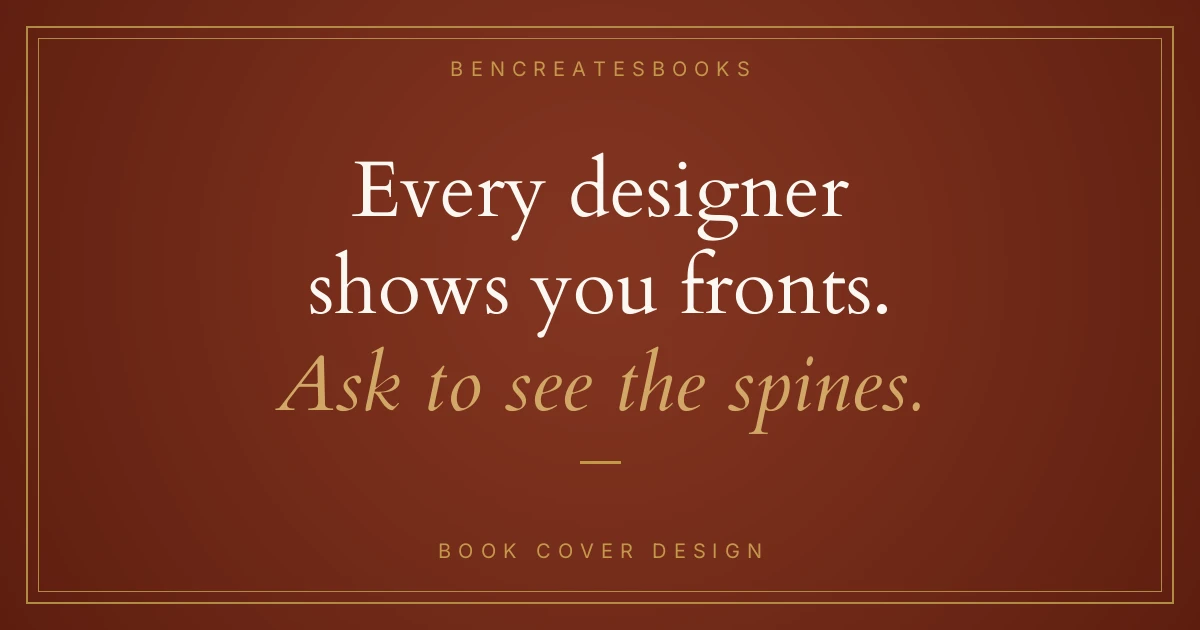
Ask to see full wraps. A front cover is half the product. Spines and back covers reveal whether a designer understands print or only pictures: spine typography, back cover hierarchy, blurb layout, barcode placement. Designers who only show fronts often only design fronts, and the wrap becomes your problem at upload. Our portfolio shows complete books for this reason.
Real books in the wild. Covers attached to live listings, ideally with the author's name you can verify. Mockups are renders; listings are evidence.
The questions to ask before any deposit
- What is your process, in order? You want: brief and research, concepts, refinement, full wrap, print files. Vague process means improvised process.
- How many initial concepts, and how many revision rounds? Get numbers in writing. "Unlimited revisions" at a very low price means the first concept is the product and revisions are attrition.
- What exactly do I receive? Print ready PDF for the full wrap at your final page count, ebook cover, and ideally the layered source files or a clear policy on them. Ask before, not after.
- How is imagery licensed? Stock photography must be licensed for commercial book cover use, and the license terms (print run limits on some stock tiers) belong in the open. A cheap cover built on unlicensed images is a liability with your name on it.
- What do you need from me, and when? A professional asks about trim size, final page count, back cover copy and your comparable titles. A designer who asks for nothing but a title and a vibe is guessing in your genre at your expense.
- What happens if my page count changes? It changes for almost everyone. The answer should be a small adjustment fee or included tweak, quoted now, not a rebuild quote later.
Price tiers, honestly
Premade covers run $50 to $150: an existing design with your name on it, fast and sometimes excellent, with the risk your book's face belongs to no one but also fits no one specifically. Freelance custom work runs roughly $150 to $500 with wide quality variance. Established studios and specialists run $350 to $1,500+, ours starting at $350 for a custom cover with the full wrap built to your printer's template, and the premium buys process, genre record and accountability, not just pixels. Below these ranges, corners are being cut somewhere you cannot see yet. Above them, you are paying for name and demand, which is sometimes worth it for a lead title.
Red flags we would walk away from
- No questions about the book itself, the genre or the reader
- A portfolio of fronts only, all in one genre that is not yours
- No interest in trim size, page count or printer
- Covers that look like the current bestseller with the title swapped; imitation dates in a season and can invite real trouble
- Resistance to putting deliverables, rounds and timelines in writing
And one question worth asking any designer now, us included: what is your position on templates and generative imagery? Ours is on our cover design page in plain words: custom work, no templates, no recycled layouts, no generative AI. Whatever a designer's policy is, it should be stated as plainly, because your readers and retailers increasingly ask.
The brief that gets you a better cover
Bring: your genre and five comparable titles (with what you admire in each), your final or near final page count and trim, the one feeling the cover must produce, your back cover copy, and your series plans if any. Authors who brief like publishers get covers like publishers. Then let the designer design; the most common way good covers die is a client art directing by committee of relatives.
FAQ
Should I hire the same designer for the whole series? Ideally yes. Series consistency is a sales asset, and the original designer holds the system in their head and files.
What if I hate the first concepts? With a real process, concepts are directions, and one is refined. If all directions miss, the brief is usually the gap; a professional will say so and re-brief rather than randomly generating more.
Do I own the cover? You receive usage rights for the book and its marketing; full copyright transfer and source files are separate arrangements. Whatever the deal, get it in writing.
How long does a professional cover take? Typically two to four weeks with revisions, longer in busy seasons. Rush is possible; panic is expensive.
Leave a Reply